

A Practical Guide to Capacity, Mobility and Compatibility
When it comes to ophthalmic surgery – especially cataract procedures – it’s crucial to have clinically appropriate intraocular lenses (IOLs) readily available. Because surgeons often confirm the exact lens power that they need during or directly prior to a procedure, clinical teams must keep a wide range of IOLs well-organized, easily accessible and properly secured within their facilities.
That’s where Harloff IOL carts come in.
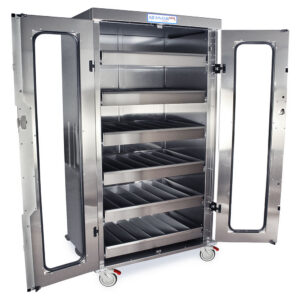
What is an IOL cart and who uses them?
An IOL cart is a specialized medical storage cabinet designed to hold and organize large quantities of boxed intraocular lenses from variety of IOL manufacturers. These carts are most commonly used by:
- Ophthalmic surgeons
- Nurses and surgical technicians
- Ambulatory surgery centers (ASCs)
- Hospitals and ophthalmology departments
Unlike general storage cabinets, IOL carts are specifically designed for meeting the unique demands of IOL inventory: reliable security, custom variability and the need for fast access during time-sensitive procedures.
Because of how niche this storage need is, relatively few manufacturers focus on this category. Harloff is one of the only companies dedicated to producing IOL-focused storage solutions as notably, these carts didn’t originate as generic storage cabinets. They were developed in response to real customer requests from the ophthalmology field trying to solve practical workflow challenges.
What all Harloff IOL Carts have in common
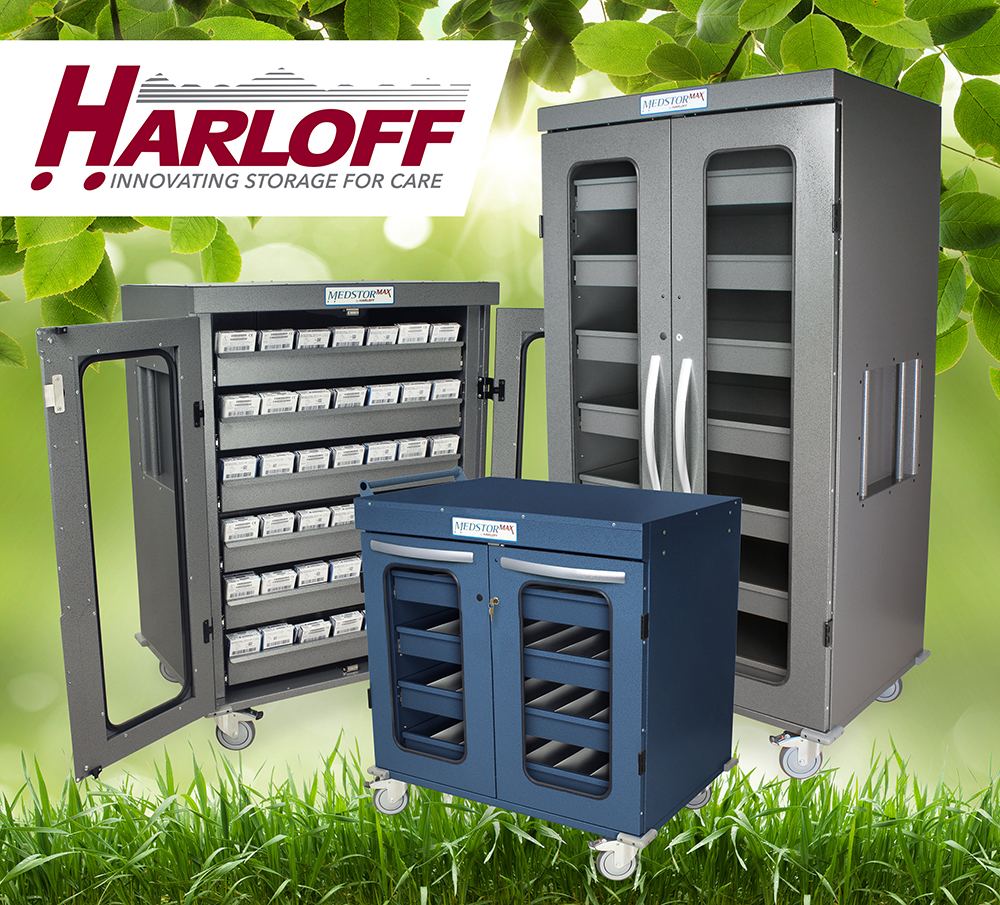
Before diving into the differences, it’s important to understand what stays consistent across the entire product line. Every Harloff IOL cart includes:
- Your choice of lock and color (including stainless steel finishes)
- Premium 5” quiet rolling casters for smooth, effortless mobility
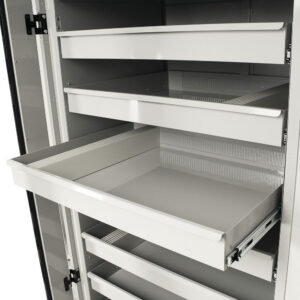
- Ball-bearing full extension drawer slides that offer easy, instant access
- Glass windows for clear visibility of supplies and inventory
- Double doors that swing up to 270 degrees
- A 24” interior cabinet depth optimized for IOL storage
- Recessed side push handles that ease transporting cabinets
- An industry leading 12-year manufacturer’s warranty
Additionally, customization is always an option with Harloff. Many configurations in this product line’s current lineup exist because customers requested something specific to meet their own unique requirements, such as the need for more vertical space, different material constructions or unique workflow considerations.
Understanding the key differences: What actually matters
When choosing an IOL cart, most decisions come down to three key factors:
- Capacity – How many boxes need to be stored
- Mobility – How often the cart will be transported
- Compatibility – What types and sizes of IOL boxes a facility uses
Each model within the Harloff IOL Cart line is designed around fulfilling a different balance of these factors.
The spectrum: From mobility to maximum capacity
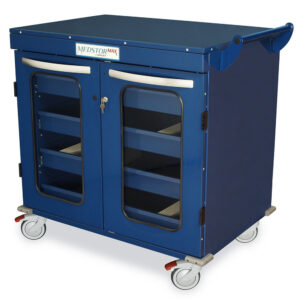
MS-IOL840: Point-of-use mobility
At one end of the IOL Cart spectrum is the MS-IOL840: a compact, highly mobile cart designed for flexibility that’s capable of storing up to 840 IOL boxes.
This model is often used for:
- Transporting a small stock of lenses into the operating room
- Acting as a staging cart for individual cases
- Supporting workflows where mobility is critical
This model’s smaller footprint and maneuverability make it ideal for ORs where space is limited or where lenses are frequently moved between rooms.
MS-IOL1260: The balanced, all-purpose option
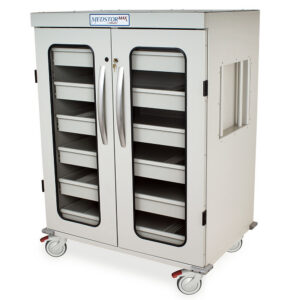
Moving up in capacity, the MS-IOL1260 represents a middle-ground solution capable of storing up to 1260 IOL boxes.
This model is commonly chosen by:
- Smaller practices or solo surgeons
- Multi-specialty centers where IOL procedures are only part of the case mix
- Facilities that need more storage than a compact cart, but not a full high-capacity cabinet
It strikes a balance between storage and mobility—large enough to serve as a primary solution in some settings, but still manageable to reposition and easily transport when needed.

MS-IOL1680: Maximum capacity and centralization
At the opposite end of the spectrum is the MS-IOL1680, designed for high-volume environments as this model features Harloff’s highest IOL box capacity at 1680.
This model is typically used as:
- A centralized IOL storage hub
- A primary inventory system for large ASCs or hospitals
- A standardized solution for managing large volumes of lens inventory
While it remains mobile, its large size means it is most often kept in a fixed location outside of ORs. For facilities managing extensive IOL inventory, it reduces the need for multiple smaller carts while still helping to maintain the organization of boxes at scale.
Compatibility-driven models: When box size matters
Not all IOL packaging is the same—and this is where Harloff’s lineup becomes especially versatile.
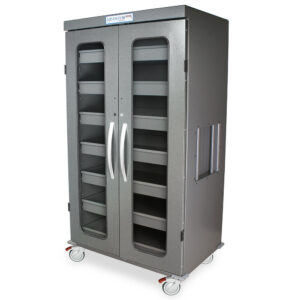
MS-IOL1470: Mixed packaging compatibility
The MS-IOL1470 is designed for facilities that use a mix of standard and slightly larger IOL box formats with a maximum capacity of 1470 IOL boxes.
To accommodate this, the cart:
- Uses fewer drawers
- Features increased vertical space between drawers
This allows operating staff to:
- Store multiple brands of IOLs in one cart
- Avoid separating inventory by packaging size
- Simplify organizational needs across surgeons and individual preferences
For many practices, this model eliminates a common frustration: realizing that certain boxes simply don’t fit in standard configurations.
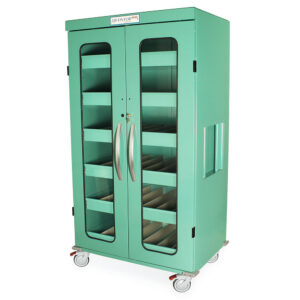
MS-IOL1092: Maximum vertical clearance and flexibility
For even more demanding storage needs, the MS-IOL1092 offers approximately 10.75” of vertical space per drawer and a total IOL capacity of 1092 boxes.
This model is ideal for:
- Oversized or specialty IOL packaging
- Facilities with evolving inventory requirements
- Mixed-use storage (IOLs alongside other supplies or equipment)
It’s often selected as a problem-solving solution, especially instances where standard drawer spacing just doesn’t work. With fewer drawers and more clearance, this model prioritizes adaptability over maximum capacity.
Material matters: Stainless steel options
Beyond size and configuration, material is another important consideration when comparing IOL storage solutions.
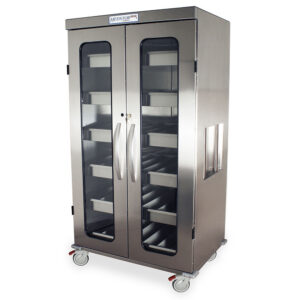
The MSS-IOL1092 represents a stainless steel equivalent of the MS-IOL1092, but this isn’t limited to just one model. Stainless steel designs can be applied to all Harloff IOL cart configurations.
Facilities often choose stainless steel options for:
- Durability and corrosion resistance
- Ease of cleaning and disinfection
- Alignment with existing OR equipment
This makes it especially relevant in environments where carts may be brought into or near the OR.
The tradeoffs for going stainless are pretty straightforward:
- Higher upfront cost compared to steel IOL Carts
- More visible fingerprints and surface marks
For many clinical settings however, the benefits of stainless designs clearly outweigh the negative aspects, particularly when consistency with other medical equipment is a priority.
Putting it all together: How to choose the right model for your facility
Rather than thinking of these carts as separate products, it’s helpful to think of them as part of a system.
Start with a few key questions:
- How much IOL inventory will you regularly need to store?
- Smaller (840), mid-range (1260), or high capacity (1680)
- Do you need to transport the cart frequently?
- Highly mobile (840), moderately mobile (1260), mostly fixed (1680)
- What types of IOL boxes do you use?
- Standard only (1260, 1680)
- Mixed sizes (1470)
- Oversized or variable (1092)
- Do you have specific material requirements?
- Will standard steel designs meet your needs or are stainless options preferred
Many facilities ultimately use more than one type of cart, for example:
- A large central cart for storage
- A smaller mobile cart for case preparation
Designed with help from real-world ophthalmologist needs
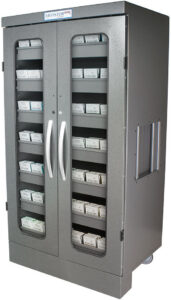
One of the defining characteristics of Harloff’s IOL cart lineup is that it wasn’t designed in isolation. Each model exists because a customer encountered a real challenge requiring a distinctive solution:
- “We need something smaller to bring into the OR.”
- “Our boxes don’t all fit in the same drawers.”
- “We need more vertical space designed for taller IOL boxes.”
- “We require a stainless steel design to match our existing equipment.”
These are real requests that led directly to the creation of custom IOL storage solutions.
Final thoughts
Choosing the right IOL Cart isn’t just about capacity; it’s about aligning the right storage solution with your facility’s own individual needs.
Whether you need:
- A compact, mobile cart for point-of-use access
- A balanced, all-purpose solution
- A high-capacity centralized system
- Or a specialized configuration for unique packaging
There’s a specific configuration designed to meet that need.
And if there isn’t? It can likely be built because customization has always been part of the Harloff process.
If you’re evaluating options to enhance or innovate how your staff currently store IOLs, starting with these distinctions – capacity, mobility, compatibility and material – will help you quickly identify the perfect fit for your facility.