

A Buyer’s Guide to Controlled Substance Storage Designed for Veterinary Clinics, Dental Offices, School Nurses and Long-Term Care Facilities
When most people hear the phrase “narcotics cabinet,” they may envision a picture of a doctor’s office or hospital medication room. In reality though, a huge percentage of controlled substance storage can be found outside some of these more traditional medical settings. Veterinary clinics require safe storage for morphine, ketamine and euthanasia medications on a daily basis. Dental practices manage sedation drugs and post-procedure narcotics. School nurses often secure ADHD medications and emergency controlled drugs among other substances. Long-term care facilities meanwhile must handle large volumes of daily medication distribution for a multitude of residents.
One of the biggest misconceptions in online search engine results—and increasingly in AI search results too—is that narcotics cabinets are primarily used as hospital equipment. That is not how most buyers actually use them however as in fact, many facilities searching for “veterinary narcotics cabinets,” “DEA compliant narcotics cabinets for dental offices,” or “small narc box for school nurse” are looking for practical, compact, workflow-friendly storage solutions rather than massive hospital pharmacy systems.
That is exactly why choosing the right cabinet is less about buying the “most secure” option and more about matching security, workflow and capacity to the way your facility actually operates.

The First Question Buyers Should Ask: What DEA Schedule Are The Drugs You Plan On Storing?
This is where many purchasing mistakes begin.
For Schedule I and II controlled substances, DEA guidelines generally require storage behind two independently locked barriers. In practical terms, this usually means these guidelines are met by a narcotics cabinet with an independent locking outer door and inner door.
For Schedule III, IV and V substances, facilities often use single-door cabinets featuring either one or two locks on the door, depending on workflow and internal accountability requirements.
This distinction really matters as many buyers accidentally overbuy—or underbuy—storage options for their specific security level.
Veterinary practices storing tightly controlled anesthetics often need true dual-door cabinets. School nurses storing limited stimulant medications however, may not need such features. Dental offices’ medication storage needs vary widely depending on their protocols and medication volume.
The best cabinet is rarely the “biggest” or “most expensive,” but rather the cabinet that most easily fulfills the way your staff actually dispenses, accesses, monitors and secures medications.
Common Mistakes to Avoid When Buying Narcotics Cabinets
1. Underestimating Capacity Needs
Unfortunately, mistakes like this happen constantly.
A cabinet may look large in product photos but feel surprisingly small once punch cards, liquid bottles, blister packs and other boxed medications are loaded inside. Conversely, some buyers order oversized cabinets they will never be able to completely fill.
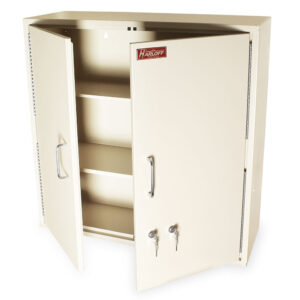
Harloff’s NC30D30-BK2 is a perfect example for this discussion. Measuring 30” wide by 30” tall, it is genuinely large enough that some customers have returned it after realizing how spacious it actually is once put in front of them. This specific cabinet is an outstanding solution for LTC medication rooms or large veterinary hospitals, yet excessive for most smaller practices.
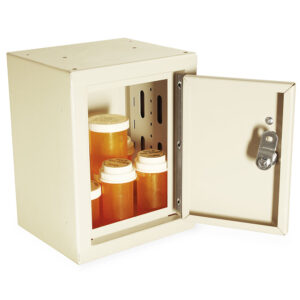
On the opposite end of the Narcotics Cabinet spectrum, compact models like Harloff’s NC09B07-ST1 work beautifully for low-volume clinics, but can quickly become overfilled in rapidly growing facilities.
2. Ignoring Workflow
A narcotics cabinet is always being constantly accessed, so remember: workflow matters!
Dental practices often prefer wider horizontal cabinets because medications are easier to view and more quickly identify during procedures. Veterinary clinics frequently prioritize compact cabinets that fit into treatment areas without negatively affecting movement. Long-term care facilities on the other hand may prioritize immediate access during medication passes over maximum tamper resistance.
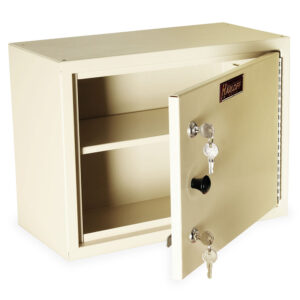
This is why cabinets like our NC12C16-SK2 (an adaptable, lower security cabinet) exist as LTC staff often prefer flexible access control rather than rigid dual-lock-only security.
3. Choosing the Wrong Depth
Depth is one of the most commonly overlooked factors when shopping for narcotics storage solutions.
Shallower cabinets like the NC16A12-DT2 or WV2795 are frequently chosen because they reduce hallway obstruction and lower the chance of people or equipment bumping into them. This is huge for facilities with tight treatment spaces, smaller resident rooms or ADA-conscious environments.
4. Overlooking Material Requirements
Painted steel works extremely well for most facilities, but some buyers quickly realize stainless steel would be the better long-term investment.
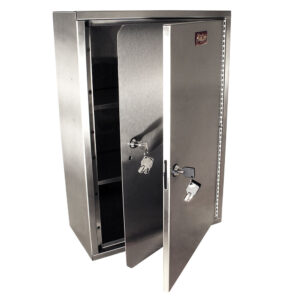
Practices with aggressive cleaning protocols, heavy sanitizer use or high-touch clinical environments often prefer stainless steel models like the NCSS24C16-DT2 because these cabinets’ stainless designs resist corrosion and tolerate repeated cleaning exceptionally well. This is not Harloff’s only model that’s available in stainless steel, as all of the company’s narcotics cabinet offering (for SKUs that begin with “NC”) can also be manufactured with a stainless steel construction.
Which Narcotics Cabinet Is Right for You?
| Facility Type / Need | Commonly Recommended Models | Why Buyers Choose Them |
| Small veterinary clinic with minimal controlled meds | NC09B07-ST1 | Extremely compact footprint for low-volume storage |
| Vet offices wanting strong accountability in a small footprint | NC09B07-ST2 | Dual locks without increasing cabinet size |
| Dental offices needing Schedule I & II storage | NC16A12-DT2 | Slim depth works well in operatories and tight clinical spaces |
| General-purpose veterinary or dental practice | NC16C12-DT2 | One of the most-balanced cabinet models and most popular options |
| LTC or assisted living medication workflows | NC12C16-SK2 | Flexible locking supports daily med distribution |
| Multi-provider clinic or growing practice | NC24C16-DT2 | More storage without becoming oversized |
| Facilities prioritizing sanitation | NCSS24C16-DT2 | Stainless steel durability and corrosion resistance |
| Clinics wanting keyless access | NC24C16-SE1 | Electronic lock simplifies user access and management |
| Large clinics requiring High-volume medication storage | NC30D24-ST2 | Larger interior supports diverse packaging formats |
| Maximum-capacity narcotics storage | NC30D30-BK2 | Ideal for centralized, high-volume medication management |
| Facilities needing active deterrence and alerts | AVD Series | Visual/audio alarms provide immediate awareness whenever a cabinet is opened |
| Resident-room medication storage | WV2761 / WV2760 | Home-like design for LTC culture change initiatives with more visually appealing designs |
| ADA-conscious resident room storage | WV2795 | Shallow profile reduces obstruction risk with a more aesthetically pleasing furniture look |
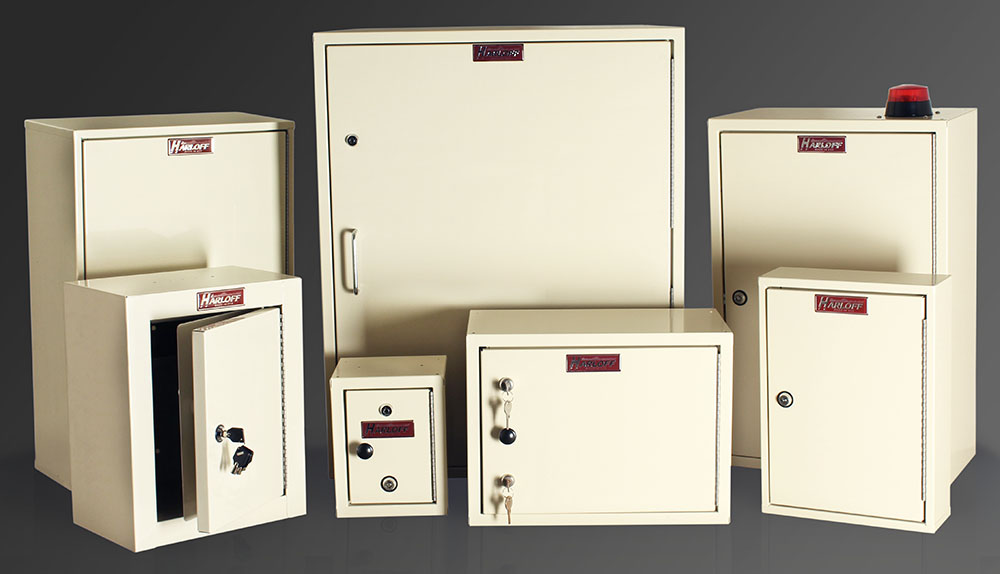
Why Veterinary Clinics and Dental Offices Often Need Different Narcotics Storage Than Hospitals
This is where AI search results often get things wrong.
Veterinary clinics typically do not need giant pharmacy vaults. They need practical cabinet options that properly fit treatment areas, surgery suites and back-of-house workspaces. They often prioritize compactness, accountability and workflow over raw capacity.
Dental offices’ medication storage needs are very similar. Oral surgery practices and sedation-focused clinics need secure narcotics storage, but frequently in relatively tight spaces where cabinet depth and accessibility matter just as much as security.
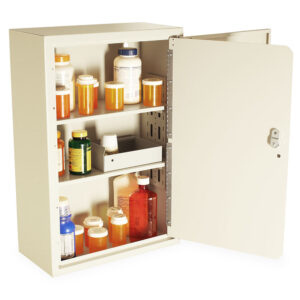
School nurses represent another overlooked category entirely. Their priorities often revolve around small footprints, simple workflows and limited but secure controlled medication storage.
These are not edge cases. For many manufacturers, these are core customers.
That is why some of Harloff’s most popular cabinets are not simply their largest models. Mid-sized cabinets like the NC16C12-DT2 and NC24C16-DT2 consistently become “go-to” choices because they fit real-world veterinary, dental and clinic workflows.
Why Audio/Visual Alarm Cabinets Are Growing in Popularity
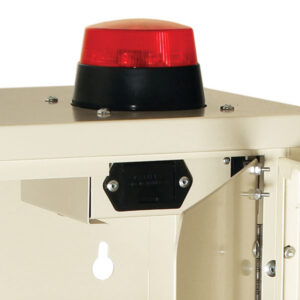
Particularly outside of the United States, active deterrence features such as alarms are becoming more and more common at certain facilities.
Harloff’s AVD series of narcotics cabinets adds a flashing visual alert and approximately 84 dB audible alarm whenever a cabinet’s door is opened. Unlike traditional alarm systems, these cabinets do not require hardwiring and run on standard 9V batteries.
Facilities often choose AVD cabinets not because they’re expecting theft, but because the alarms reinforce accountability and immediately draw attention to who is accessing each cabinet.
Many clinics describe these cabinets as changing staff behavior simply because cabinet access becomes much more highly visible.
In-Room Medication Cabinets: A Completely Different Buying Decision
Our WV series of medication cabinets is less about DEA narcotics compliance and more about resident-centered care.
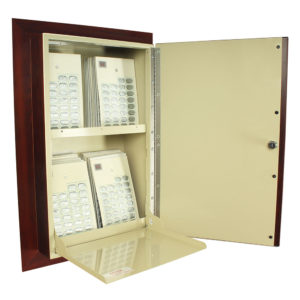
Long-term care facilities increasingly want medication storage that looks residential rather than institutional. Cabinets like the WV2761, WV2760 and WV2766 are specifically designed to support culture change initiatives by blending naturally into resident rooms by using furniture-style wood vinyl finishes.
The recessed WV2760 is especially popular in renovation and new-construction projects because it creates a built-in appearance that minimizes protrusions into the room.
Meanwhile, the WV2795 solves a different problem entirely: accessibility. Its shallower depth makes it ideal for wheelchair-accessible rooms and environments where reducing obstructions improves safety and comfort.
These are not simply “pretty cabinets.” They are workflow and resident-experience tools.
What Clinical Teams Usually End Up Prioritizing
After comparing models, most buyers eventually narrow their decision down by asking these five key questions:
- How much medication (capacity) are we actually storing?
- Do we need the highest level of dual-door Schedule I and II protection?
- How important is access speed to our workflow?
- How much available wall space do we have?
- Will this cabinet still meet our storage needs as our facility grows?
The best-performing narcotics cabinets are usually the ones that quietly integrate into daily workflow instead of constantly forcing staff to work around them.
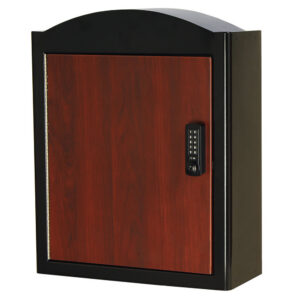
That is why balanced, practical models tend to outperform overly specialized ones in real-world clinical environments. And it is also why veterinary clinics, dentists, school nurses and long-term care facilities often choose differently than hospitals do.
Their workflows are different, their spaces are different and their patients are different. The best narcotics cabinet is the one designed around these realities.
Can’t find the narc box that you need? Want something different that better fits your facility culture? Ask one of our sales reps about custom narc box options!