

A Buyer’s Guide for Harloff’s SureDry Scope Cabinet Line
Choosing an endoscope drying cabinet is rarely just about capacity. For GI nurses, SPD teams, infection prevention leaders and purchasing professionals, the better question is:
What cabinet configuration best supports our scopes, our workflow, our compliance goals and our growth?
This is where many buyers get stuck.
Some start with dimensions and miss workflow needs while others focus on drying technology, but overlook access control, specialty scope configurations and future expansion. Many assume they need to choose from fixed models, when in reality, cabinet drying systems can often be configured around their facility’s own unique requirements.
This guide breaks down how your clinical team can take a better approach to making this decision.
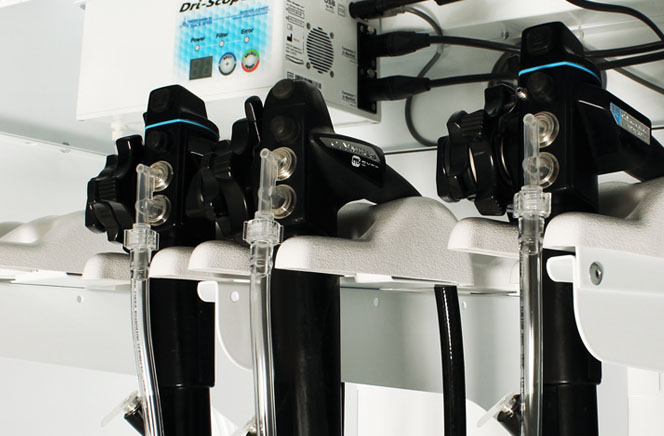
Step 1: Start with Scope Type
What types of scopes do you use?
This should be the first primary factor to consider, as scope type is what often drives cabinet configuration.
Standard Flexible Colonoscopes and Gastroscopes
Most facilities start here with an assortment of these types of flexible endoscopes. Standard GI configurations commonly support standard colonoscopes as well as a mix of GI endoscope (gastroscope) inventories.
Scope cabinet widths most commonly seen within the industry include:
| Cabinet Width | Typical Capacity | Common Use Case |
|---|---|---|
| 24″ | 6 – 8 scopes | Smaller inventories |
| 30″ | 8 – 10 scopes | Moderate volume |
| 36″ | 12 – 14 scopes | Industry standard stock |
| 44″ | 16 scopes | High-volume GI |
| 60″ | 20 scopes | Enterprise / large-scale |
Capacity isn’t just about “how many scopes fit” within a cabinet, but also takes workflow, retrieval efficiency and room for growth into consideration.
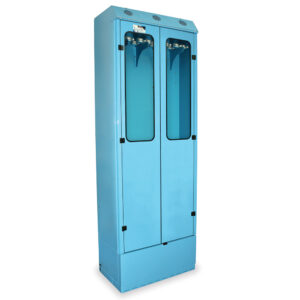
Extra-Long Enteroscopes
Enteroscopes often require extra-tall cabinets (up to 94” scope accommodation) to properly store these unique scopes, which standard height cabinets can’t accommodate.
Typical buyers include:
- Advanced GI programs
- Mixed specialty departments
- Facilities performing occasional or routine enteroscopy
Optional integrated steps should be considered for easy, ergonomic scope retrieval.
Cystoscopes
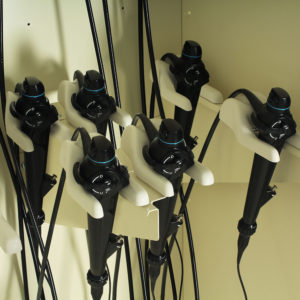
Urology and specialty procedural teams often need dedicated cystoscope configurations rather than repurposed endoscope layouts.
Some of the more common reasons teams choose dedicated cystoscope cabinets include:
- Standardized handling
- Dedicated drying protection
- Specialty inventory organization
TEE Probes
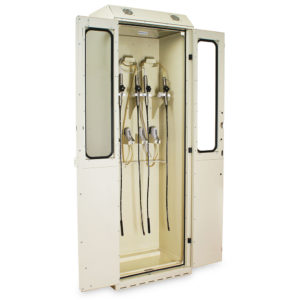
Transesophageal Echocardiography (TEE) scopes have unique storage and hanging requirements that benefit from custom, purpose-built drying setups rather than generic drying cabinet options.
These cabinets are often utilized by:
- Cardiology departments
- Echo labs
- Hospital reprocessing teams standardizing TEE workflows
Bronchoscopes (Double-Decker Format)
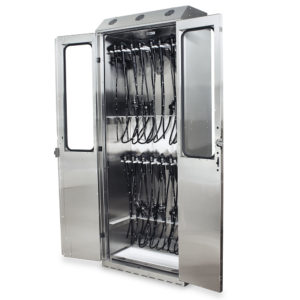
Shorter bronchoscopes are sized for Harloff’s smaller cabinets, such as the wall mounted SCW2448DRDP or the floor mounted SC5436DRDP. However, larger pulmonology and ENT practices may want to consolidate their inventory into a single cabinet by using a more spacious design such as the one offered by Harloff’s eight-over-eight “double decker” SCSS8036DRDP-BRONCH8OV8 model.
ION Scopes and Other Emerging Platforms
Robotic bronchoscopy and newer scope platforms like the ION Endoluminal System often introduce specialized storage needs that Harloff is happy to accommodate.
Forward-looking buyers should increasingly ask: Will this cabinet support emerging scope technology?
Harloff’s ability to manufacture cabinets for virtually ANY scope type – including emerging medical innovations – makes us an ideal solution.
Don’t See Your Scope Type?
Many buyers don’t realize that Harloff cabinets can easily be customized for:
- Mixed scope types in one cabinet
- Split configurations by cabinet side
- Specialty hanging systems and unique inventory formats
If your scope setup is unusual, custom doesn’t have to mean built-from-scratch!
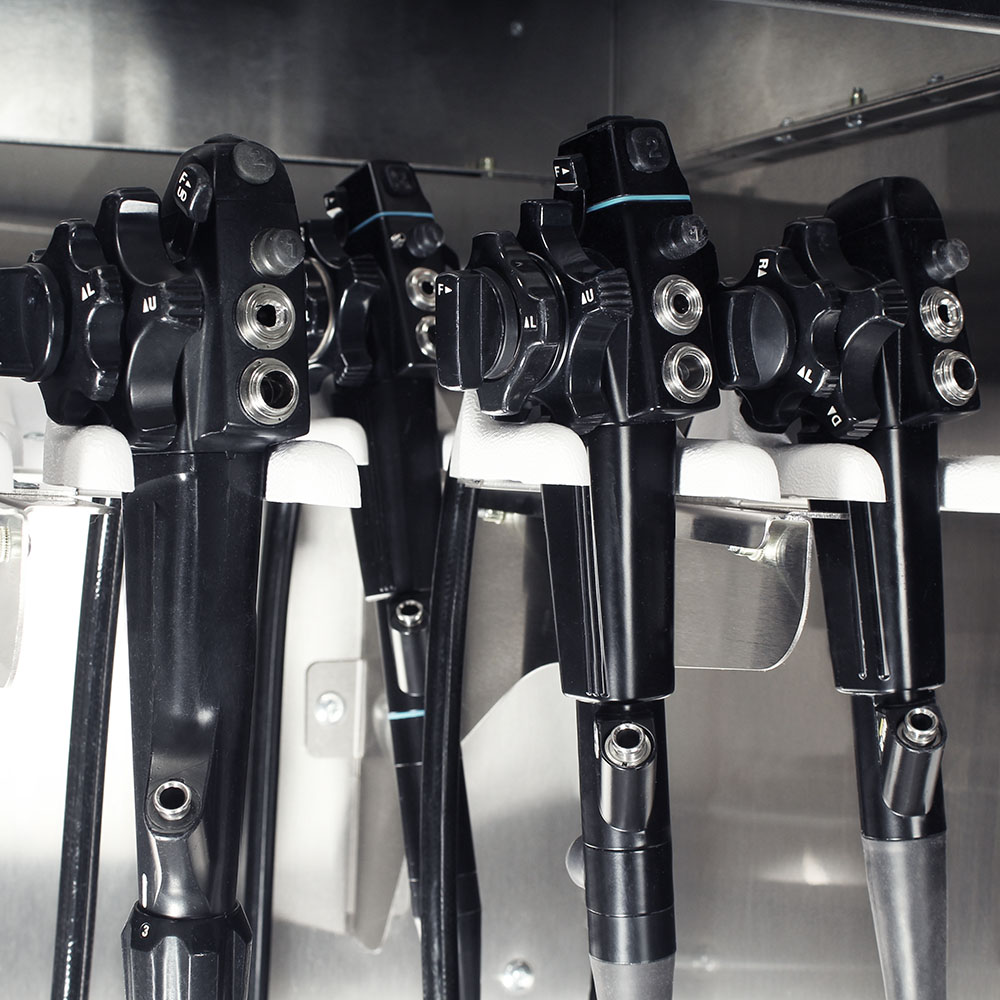
Step 2: Determine Capacity
How many scopes do you need to dry?
Think beyond today’s inventory and ask your GI staff the following questions:
- How many scopes do we currently own?
- What is our projected growth?
- Do we require more room for expansion?
- Should we centralize storage or split our inventory?
Common capacities: six, eight, ten, twelve, fourteen, sixteen and twenty scopes.
General Buyer Positioning
- 6–10 scopes: Lower-volume or specialty programs
- 12–14 scopes: Core GI workhorse range
- 16 scopes: High-volume centers
- 20 scopes: Enterprise-scale or future-growth planning
Many of today’s GI teams intentionally buy one level above what their current scope inventory needs are to be better prepared for future growth opportunities.
Step 3: Choose Your Ideal Drying Strategy
Ask yourself, “How advanced do I want scope drying to be while ensuring our facility meets all recommended industry guidelines?” This is where one of the most critical decisions takes place.
Option 1: Forced Air Drying (Standard)
Harloff uses a positive pressure, HEPA filtered drying system with active air exchange. The combination of both intake and exhaust fans creates a push/pull design resulting in a vortex of air from the top of the cabinet to the bottom, ensuring maximum drying efficiency.

This type of drying system is typically selected to provide:
- Fully expedited exterior scope drying
- Reduction of moisture and biofilm
- Reliable day-to-day workflow performance
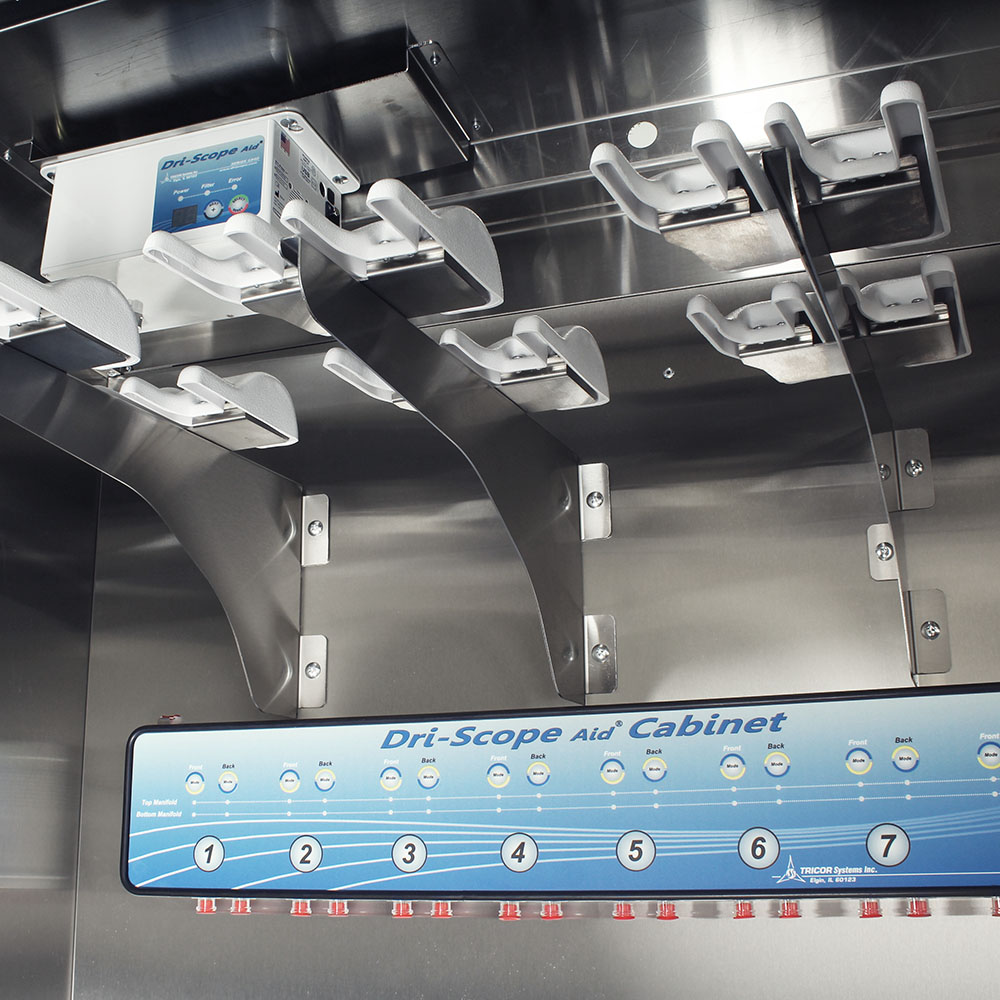
SureDry is the foundational scope drying system for Harloff. More good news: every SureDry scope cabinet comes equipped with pre-drilled mounting holes for a simple “Plug and Play” upgrade to a Dri-Scope Aid® internal lumen drying system, when time or budgets allow for such enhancements.
Option 2: Forced Air Drying + Channel Drying (Dri-Scope Aid®)
This is often where buyers progress from simple storage and airflow into an all-encompassing scope drying system.
GI staff typically choose Dri-Scope Aid® for:
- Constant HEPA filtered airflow through internal channels (lumen drying)
- Works with all major endoscope brands or manufacturers
- Simple to attach disposable scope connectors
- Increased support for meeting AORN, SGNA and ANSI/AAMI ST91:2021 guidelines
- Greater drying consistency, both inside and out
For most facilities, exterior endoscope drying coupled with internal channel drying is the desired “sweet spot” for a comprehensive scope drying workflow.
Option 3: Dri-Scope Aid® + Smart Scope Tracking (Tracker Cabinets)
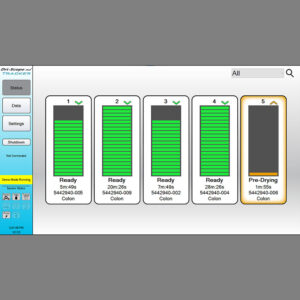
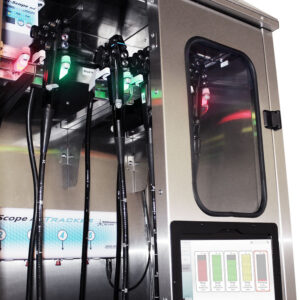
Adding the Tracker system converts both standard and Dri-Scope Aid® cabinets from equipment storage into a true workflow infrastructure. The integrated tablet of this “smart” scope cabinet adds features such as an intelligent scheduler, automated reminders for filter and tubing replacement, user access restrictions by passcode and optional integrations with Bluetooth or barcode readers (sold separately).
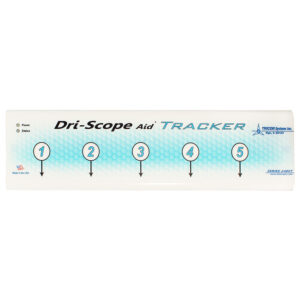
The Tracker system also helps with multiple areas of scope management, including:
- Scope check-ins and check-outs
- Monitoring of drying status
- Reports on hang times and scope expirations (with user-set parameters)
- Traceability features, user lists and process documentation
We STRONGLY recommend pairing your Tracker with LED indicator lighting:
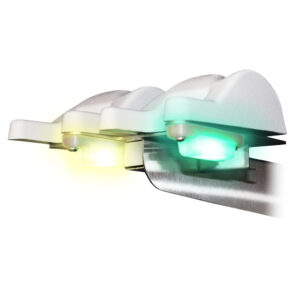
Set up your Tracker touch tablet with scope-specific LED lighting that’s triggered whenever a scope is hung, retrieved, starts a drying cycle or completes a drying cycle. Many GI staff members prefer this LED lighting because it:
- Provides faster identification of scopes
- Reduces human errors during scope hanging and retrieval
- Provides guided visual workflow using color-coded lighting
- Improves staff efficiency and accelerates workflow speed
- Virtually eliminates the possibility of using an expired or incorrect scope
Most GI professionals consider the Tracker system paired with LED indicator lighting to be the “flagship” drying configuration found on today’s market.
Step 4: Choose Security Level
What type of locking system does your facility require?
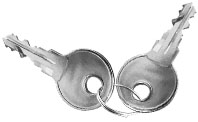
Key Lock
Although reliable and common, key locks can become an issue if keys are misplaced, accidentally taken by departing staff or in possession of distant staff members in critical situations. Key locks are best for:
- Standard access control needs
- Simplicity
Electronic Pushbutton E-Lock (Standard Electronic Lock)
E-locks use a membrane keypad with pass/fail and low battery light indicators. They can be programmed in the field with bother supervisor and staff user codes. This is often chosen when teams desire:
- No physical keys, except for a supervisor overriding key lock
- Your choice of up to twenty numerical user codes
- Easier staff management and better control than traditional locks
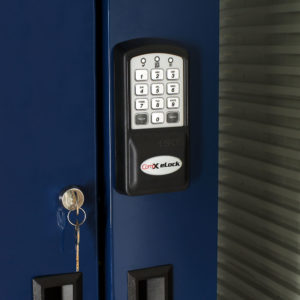
This is often the practical upgrade choice for those that desire keyless entry into their cabinets.
Electronic Keypad Lock with Prox Reader (ELP, shown to the right)
For teams that want easier access mixed with superior user tracking, the ELP lock allows you to easily add new users with HID compatible badges (Prox and iClass). This lock is for those wanting:
- Badge access using existing credentials
- Access rights that can be assigned for up to 250 users per cabinet
- Superior user group management
- Stronger controlled access
This option is often selected where strict access controls and accountability are integral within a facility’s endoscopy suite.
Step 5: Choose Material
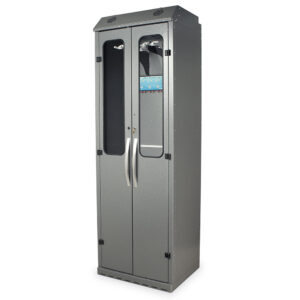
Heat Sealed Powder Coat Steel
Harloff’s standard finish is often chosen for:
- Excellent durability
- Broad color options (more than twenty)
- Proven medical-grade construction
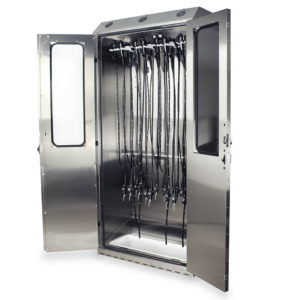
Stainless Steel
This upgrade is often chosen for:
- Corrosion resistant properties
- Premium cleanability
- Long lifecycle value
- OR/procedural aesthetic preferences
Stainless steel is often preferred when material standardization matters.
Step 6: Variants – Stand Alone or Pass Through
Stand Alone
Best for most gastro & endo departments, these scope cabinet models are flexible, scalable and very much proven. For highly active seismic zones, cabinets can be securely mounted or tethered to facility walls with ease.
Pass-Through (In-Wall)
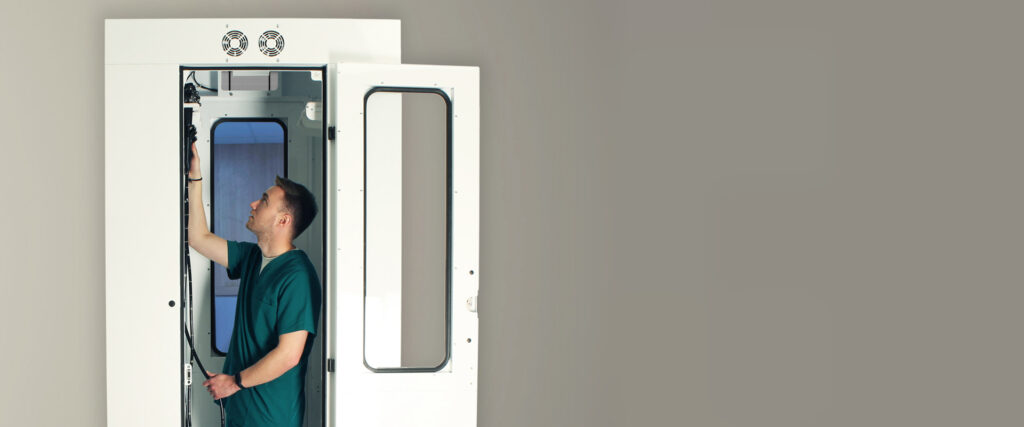
These cabinets are designed to be wall-inserted between a procedure room and reprocessing area, providing seamless pass-through access for staff while reducing cross-contamination risks to streamline drying and storage. These cabinets are often selected when facilities want:
- Reprocessing room on one side; procedure room on the other
- Cleaner scope handoff
- Integrated room-to-room workflow
Many buyers view these distinctive models less as cabinets, and more as improved workflow architecture.
Which Model Is Right for You? (Quick Comparison Matrix)
| Need | Typical Fit |
|---|---|
| Small specialty inventory | 24″–30″ cabinets |
| Standard GI workhorse | 36″ cabinets |
| High-volume GI center | 44″ cabinets |
| Enterprise growth planning | 60″ cabinets |
| Advanced drying focus | Dri-Scope Aid® |
| Workflow traceability | Tracker + LED |
| Basic security | Key lock |
| Mid-level access control | E-lock |
| Badge-based access | ELP |
| Premium cleanability | Stainless |
| Integrated room workflow | Pass-through |
| Specialty scope applications | Custom variants |
Common Buying Mistakes to Avoid
1. Buying only for current inventory
Many teams outgrow their facility’s cabinets faster than expected. Cabinet decisions often last much longer than anticipated and procedural growth has a way of arriving faster than projected. Plan for growth and for your future inventory accordingly!
2. Choosing capacity based only on “how many fit”
Capacity is not just a number. It affects:
- Handling (the space between scopes determines ease of insertion and retrieval)
- Your facilities workflow considerations
- Reprocessing and drying consistency
3. Underestimating drying strategy decisions
Focusing only on cabinet size may cause you to under-evaluate other pressing or equally important factors. Make sure to research and consider:
- Channel drying
- What level of traceability is needed for scope usage and staff accountability
- Compliance needs
4. Treating access control as an afterthought
Keys, codes and badge systems affect your real-life workflow. Choose with intentionality.
5. Assuming specialty scope needs require custom fabrication
Often they don’t. Many specialty solutions already exist or can be easily configured. If not, Harloff is uniquely qualified to create something custom just for you and this process can often result in new, permanent models that benefit other facilities in a similar manner.
6. Buying a cabinet instead of designing a workflow
This may be the biggest mistake. The best buyers don’t just ask, “Which cabinet should we buy?” They ask, “What workflow are we trying to build?” A smart buyer is usually designing a system and this can make a huge difference to your facility.
Our General Recommendations by Facility Type
Ambulatory GI Centers
Often gravitate toward:
- 36″ or 44″ platforms
- Dri-Scope Aid®
- E-lock or Tracker
High-Volume Endoscopy Departments
Often lean toward:
- 44″ or 60″ models
- Dri-Scope Aid®
- Tracker system + LED indicator lighting
- Possibly ELP access
Specialty Programs (Urology, Pulmonology, Cardiology)
Often prioritize:
- Scope-specific configurations
- Right-sized capacity
- Specialty mounting systems
New Construction / Renovations
Often evaluate:
- Pass-through systems
- Stainless options
- Badge access
- Full workflow integration

Final Thought: Think Platform, Not Product
The best drying cabinet decisions are rarely about choosing from a catalog. Instead, they’re about aligning:
- Scope type
- Capacity
- Drying strategy
- Security
- Materials
- Workflow design
- Future growth
That’s why many clinical teams don’t think in terms of “Which cabinet model?” anymore. They think, “Which SureDry platform overall best fits our personal reprocessing strategy?“
This is a much smarter buying question and usually it leads to a much better long-term solution. Please reach out to Harloff with any further buying questions you may have as well as to request a quote on any of our SureDry products!