

Evaluating The Abilities Of Crash Carts, Labor & Delivery Carts And Comfort Carts
When many healthcare facilities initially begin comparing available pediatric cart options, many professionals primarily only consider common specifications such as drawer count, lock type or cart dimensions. While those factors certainly matter, experienced clinical teams often discover that the real purchasing decision comes down to anticipated workflow.
The most successful pediatric cart implementations occur when facilities choose a cart designed around how caregivers actually work. A pediatric emergency department has very different needs than a labor and delivery unit. Likewise, a child life department distributing items specifically to help comfort young patients has entirely different goals than a team responding to pediatric emergencies.
This guide helps explain the current major categories of pediatric carts offered by Harloff, compares our available models and highlights the situations where each cart delivers the greatest value.
Understanding the Three Major Categories of Harloff Pediatric Carts
Although all pediatric carts support patient care, different designs serve VERY different purposes.
Pediatric Crash Carts
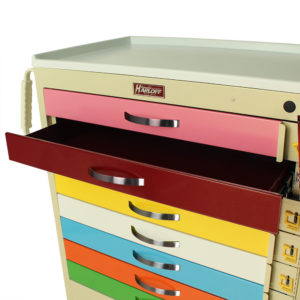
Pediatric crash carts are designed for emergency response situations. These carts are uniquely designed to store the medications, supplies and equipment required during pediatric emergencies and code blue announcements. Unlike standard crash carts, pediatric crash carts use a multi-colored drawer labeling system comparable to the Broselow color coding method that helps clinicians quickly identify supplies associated with specific pediatric size and weight ranges. Individual breakaway locking bars allow staff to access only the drawers required during an emergency while also simplifying post-event restocking.
The primary goal for pediatric crash carts is speed, organization and preparedness for any emergency involving younger patients.
Labor and Delivery Carts
Labor and delivery carts are designed around care workflows for newborns. These carts typically function as mobile workstations that support baby scales, newborn assessments, examinations, supply organization and documentation. In many of these cases, the workspace itself becomes more important than the storage capacity.
The primary goal of a labor and delivery cart is to bring supplies and workspace directly to the needed point of care during newborn procedures or baby examinations.
Comfort Carts
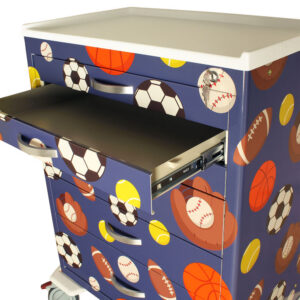
Comfort carts focus on patient experience rather than clinical intervention. These carts are commonly used by child life specialists, nursing departments, therapy programs or patient experience teams to distribute toys, sensory items, books, snacks, comfort products, rewards and other engagement activities.
The primary goal of a comfort cart is to reduce anxiety, improve morale and create more positive healthcare experiences for pediatric patients.

Pediatric Crash Cart Comparison Guide
The Core Pediatric Crash Cart
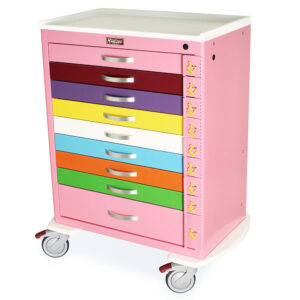
For most healthcare facilities, the MDS3030B09PED represents the starting point. This model combines nine drawers, pediatric color-coded organization, individual breakaway drawer bars, ergonomic push handles, full-extension drawer slides, and Harloff’s durable M-Series steel design into one reliable pediatric cart design.
Facilities commonly choose this model when they need a dedicated pediatric emergency cart without additional accessories or specialty requirements.
Best for:
- Emergency departments
- Pediatric units
- Children’s hospitals
- Ambulatory surgery centers
- Facilities building a standardized pediatric crash cart program
The Ready-to-Deploy Version
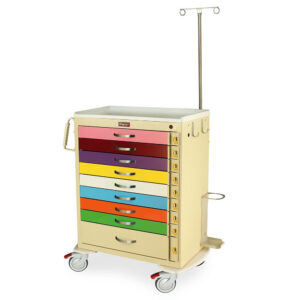
The MDS3030B09PED-EMG model builds upon the core MDS3030B09PED model by adding essential crash cart accessories to the cart, including an IV pole, oxygen tank holder, utility hooks, cardiac board and drop shelf. This configuration is ideal for facilities that already know they will need these accessories to best administer emergency care to patients and who also prefer a more turnkey solution.
Best for:
- New installations
- Facilities replacing older crash carts
- Organizations seeking a more traditional crash cart configuration
The Fully Equipped Pediatric Emergency Cart
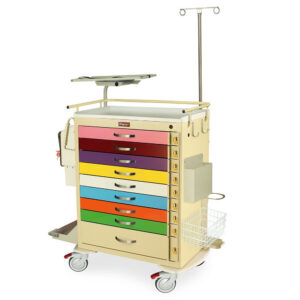
The MDS3030B09PED+MD30-EMG3 package represents the most comprehensive emergency configuration Harloff has to offer. Additional accessories for this model include a defibrillator shelf, suction shelf, sharps container holder, chart holder, utility basket, drawer dividers, top rail system, and other workflow-focused items.
Facilities typically choose this model when they want to maximize equipment integration and minimize future accessory purchases.
Best for:
- Pediatric emergency departments
- High-acuity environments
- Facilities seeking the most complete emergency workstation
Premium Lightweight Pediatric Crash Cart
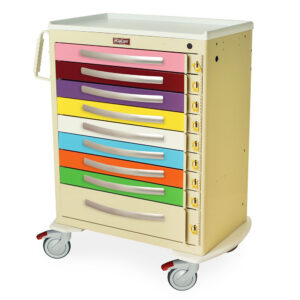
The A-Series MPA3030B09PED model offers the same pediatric emergency organization as the MDS3030B09PED, but with an upgraded lightweight aluminum construction, self-closing drawer slides and more aesthetically appealing drawer handles. The primary advantages of this specific model are the cart’s enhanced mobility as well as the improved premium user experience it offers.
Best for:
- Facilities frequently moving carts
- Organizations seeking premium construction
- Buyers prioritizing staff ergonomics
MRI-Compatible Pediatric Crash Cart
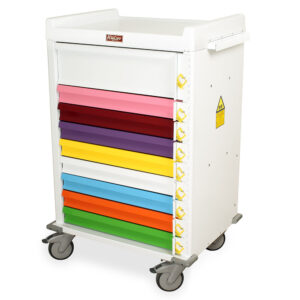
The MR9B-PED exists for one reason: MRI safety. Constructed from non-magnetic and weakly magnetic materials, it allows facilities to maintain pediatric emergency readiness within or around MRI environments that are approved for use in a 3 Tesla or less environment.
Best for:
- Children’s hospitals
- MRI suites
- Pediatric imaging centers
- Radiology departments
Pediatric Crash Cart Selection Matrix
| If your facility says… | Recommended Model |
|---|---|
| “We need a standard pediatric crash cart.” | MDS3030B09PED |
| “We need a crash cart with common crash cart accessories included.” | MDS3030B09PED-EMG |
| “We want the most comprehensive emergency accessory package available.” | MDS3030B09PED+MD30-EMG3 |
| “We want a lighter, easy-to-navigate premium cart.” | MPA3030B09PED |
| “We need a pediatric cart designed for safe use in MRI suites.” | MR9B-PED |

Labor and Delivery Cart Comparison Guide
The Core Labor & Delivery Workstation
The MDS3030K06+MD30-SSFLTOP model serves as the foundation of Harloff’s labor and delivery cart offering. The defining feature is the stainless steel top with dual fold-out stainless steel shelves that create approximately 58.5 inches of additional workspace when fully extended.
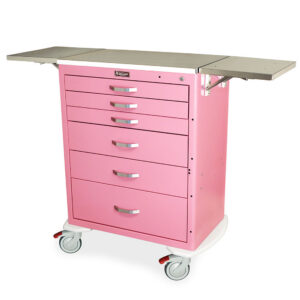
This workspace is ideal for holding baby scales, performing newborn assessments, examinations and documentation.
Best for:
- Labor and delivery departments
- Postpartum units
- Nurseries
- NICUs
- Pediatric clinics
Premium LDRP Cart with Electronic Lock
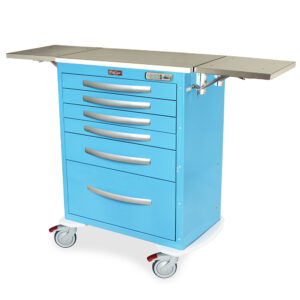
The MPA3030E16+MD30-SSFLTOP model upgrades the core workstation model with its A-Series aluminum construction and a programmable electronic pushbutton lock. The result is improved mobility, keyless access, enhanced security management and enhanced aesthetics.
Best for:
- Facilities preferring keyless access
- Multi-shift environments
- Departments concerned about key management
- Premium labor and delivery installations
Furniture-Style Delivery Cart
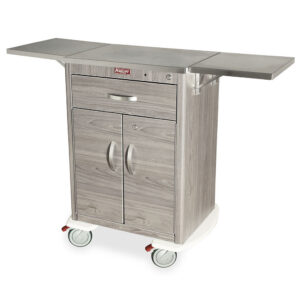
Not every labor and delivery environment wants a traditional clinical appearance for their medical carts. The MWA2427K01-21DR-DG+MD24-SSFLTOP model combines the extended stainless steel workspace concept seen with our other LDRP cart designs with a woodgrain furniture-style exterior that features two swinging doors for more of a cabinet storage design.
Best for:
- Birthing centers
- Family-centered care environments
- Hospitality-focused healthcare settings
- Facilities emphasizing patient experience
Baby Scale Cart
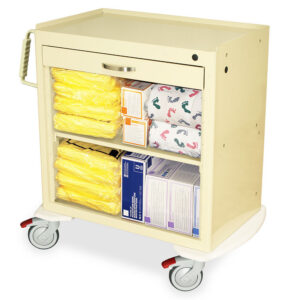
The MDS3024SC focuses on simplicity. Instead of a large workstation, it provides a dedicated baby scale platform with a single drawer and open storage area beneath the top of the cart. This makes it an economical solution for weighing newborns and routine supply access.
Best for:
- Nurseries
- Pediatric clinics
- Postpartum units
- Departments seeking a dedicated baby scale station
Labor & Delivery Selection Matrix
| If your facility says… | Recommended Model |
|---|---|
| “We need a mobile newborn workstation.” | MDS3030K06+MD30-SSFLTOP |
| “We want a premium workstation with keyless security.” | MPA3030E16+MD30-SSFLTOP |
| “We want a warmer, furniture-style appearance.” | MWA2427K01-21DR-DG+MD24-SSFLTOP |
| “We simply need a baby scale cart.” | MDS3024SC |

Comfort Cart Comparison Guide
Full-Wrap Comfort Cart
The MDS3030K06+MDFW full-wrap comfort cart is designed to maximize visual impact. The entire cart body is covered with a pediatric-friendly vinyl wrap, helping transform the cart from clinical equipment into a more engaging part of the patient experience.
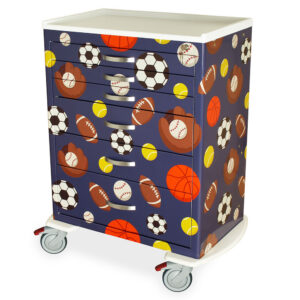
These carts are commonly used to distribute toys, sensory items, books, crafts, snacks, rewards, comfort products and child life resources.
Best for:
- Children’s hospitals
- Child life programs
- Pediatric specialty clinics
- Patient experience initiatives
Premium Partial-Wrap Comfort Cart
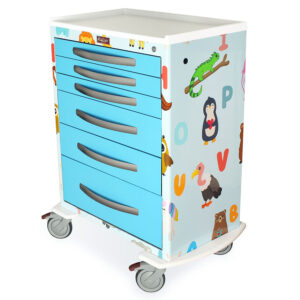
The MPA3030K06+MDPW model combines the benefits of Harloff’s premium A-Series platform with a partial-wrap option. The decorative graphics remain highly visible all over the cart’s body while this model’s painted drawer fronts offer a slightly more balanced and professional appearance. The aluminum construction and self-closing drawers also improve mobility and everyday usability.
Best for:
- Facilities seeking a premium comfort cart
- Mixed-use clinical environments
- Organizations wanting a balance of visual impact and traditional appearance
Match Your Facility’s Branding with a Custom Cart Wrap
Although Harloff offers pre-selected patterns to choose from, you can cover any M-Series steel cart or A-Series aluminum cart with a custom design of your own. Organizations may provide fully customized designs incorporating branding, logos, colors, or facility-specific artwork. These wraps typically use repeatable patterns, but can be single images like hospital logos, photographs or virtually any other image with a high enough resolution.
Scalable vector files (.ai or .eps) work best, but pixel based images (.psd, .tif, etc) may be acceptable if they have a minimum resolution of 300 dpi.
Comfort Cart Selection Matrix
| If your facility says… | Recommended Model |
|---|---|
| “We want maximum visual impact and patient engagement.” | MDS3030K06+MDFW |
| “We want a premium comfort cart with a more balanced appearance.” | MPA3030K06+MDPW |

Common Buying Mistakes to Avoid
One of the most common mistakes facilities make is purchasing based on storage capacity alone. For example, labor and delivery teams often benefit more from workspace than additional drawers. Similarly, comfort cart programs frequently achieve greater success by focusing on patient engagement and accessibility rather than maximizing storage volume.
Another common mistake is underestimating workflow differences between departments. A crash cart optimized for emergency response may be completely unsuitable for newborn assessments. Likewise, a labor and delivery workstation may not support the goals of a child life program.
Organizations should also consider long-term mobility requirements. Departments that move carts frequently often appreciate the benefits of lightweight aluminum models, while facilities that prioritize value or have a limited budget may prefer Harloff’s traditional steel models.
Finally, many buyers focus exclusively on today’s needs. Future expansion, additional accessories, evolving workflows and increasing patient rosters should all be considered during the purchasing process.

Which Model Is Right for You?
The simplest way to choose the right pediatric cart is to start with your intended workflow rather than a cart’s specifications.
If your primary concern is pediatric emergency preparedness, begin with the pediatric crash cart family.
If your goal is newborn assessment, weighing and point-of-care workflow support, focus on the labor and delivery cart lineup.
If your objective is improving patient experience, reducing anxiety and creating a more pediatric friendly environment, our comfort cart offering is likely the best fit.
Once the category is selected, the remaining decision typically comes down to mobility, security, accessories, aesthetics and specialized requirements such as MRI compatibility.
Healthcare organizations that align their cart selection with their clinical workflow almost always achieve better long-term results than organizations that focus solely on specifications. The right cart is ultimately the one that helps caregivers deliver safer, more efficient and more positive patient experiences every single day!